

Blog
The top 9 advantages of Russian birch wood for fine and durable woodworking.

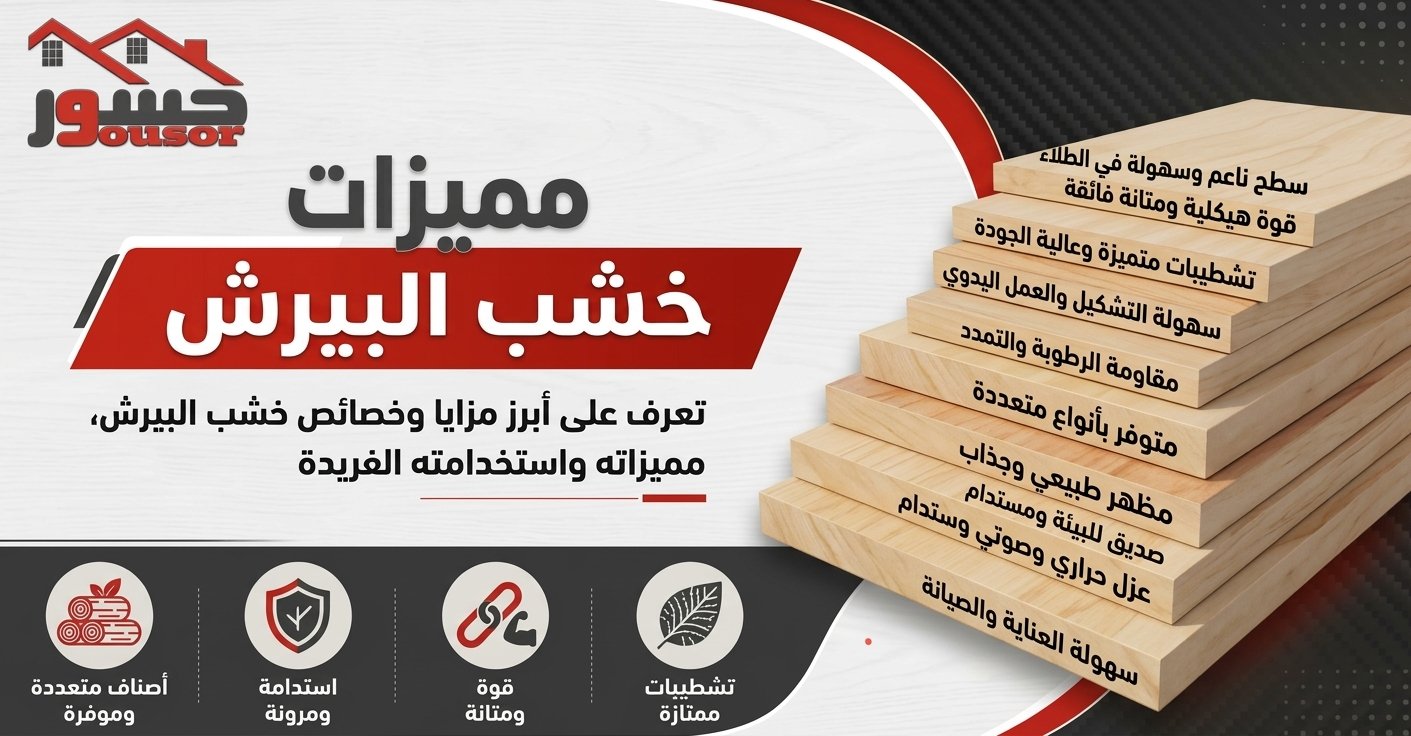
Birch wood has many advantages that have made it a preferred choice in the manufacture of furniture and wooden panels, most notably its good hardness, elegant natural appearance, ease of operation and finishing, and variety of uses.
But is it suitable for all types of furniture and kitchens? And can it withstand humidity and daily use? This guide from gousorWood ShopWe review مميزات خشب البيرش Its disadvantages, technical characteristics, main uses, and the difference between it and manufactured wood, along with the factors that determine its price, to help you choose the right material.
You can also contact us via WhatsApp to find out the most important details and prices for birch wood from Jasoor Store.
What are the main advantages of birch wood?
The most important features of birch wood are the combination of solidity, aesthetic appearance and ease of shaping, which are characteristics that make it suitable for many carpentry and interior design works. Some of these features vary depending on the type of birch used, whether it is solid natural wood or plywood panels made from its veneer.
Here are the top 9 features of birch wood that will help you assess its suitability for your project.
1. Good rigidity and ability to withstand daily use
One of the most prominent features of birch wood is its hardness, as it has good resistance to scratches and dents resulting from normal use, compared to some soft woods.
The hardness of birch wood helps it to be used in the manufacture of furniture pieces that are subject to frequent friction, such as tables, chairs and cabinets, provided that the appropriate thickness and design are chosen.
However, the hardness of birch wood varies depending on the plant species, so it is not advisable to rely solely on the commercial description when comparing materials.
2. Durability and resistance to wear and tear from use
The advantages of birch wood are also evident in its ability to serve many interior uses for years when manufactured, finished and cared for properly.
Its mechanical properties make it a good choice for home furnishings, especially when the design requires a material that can withstand frequent use.
However, a distinction must be made between durability and water resistance; strong wood is not necessarily resistant to moisture or rot.
3. Light color and attractive natural appearance
Birch is characterized by light colors that often range between creamy white and light brown, with fine and relatively uniform veins.
One of the advantages of birch wood is that its appearance is compatible with modern decorations, especially Scandinavian and simple designs that rely on calm colors and natural materials.
It can also be used with multiple colors and finishes to achieve a modern look without the need for complex decorations.
4. Ease of operation, cutting, and shaping
The advantages of birch wood include its good workability using appropriate manual and mechanical woodworking tools.
Wood can be cut, drilled, and shaped to produce a variety of pieces, taking into account the direction of the grain and the sharpness of the cutting tools to reduce the likelihood of surface tearing during operation.
This feature is useful in the manufacture of furniture that requires precise details or specific dimensions.
5. Sandability, finishing, and painting
One of the most important advantages of birch wood is the possibility of obtaining relatively smooth and uniform surfaces after sanding and proper preparation.
Many finishes can be applied to it, such as varnishes, paints and protective materials, which help to improve its appearance and protect its surface.
Many finishes can be applied to it, such as varnishes, paints and protective materials, which help to improve its appearance and protect its surface.
Many finishes can be applied to it, such as varnishes, paints and protective materials, which help to improve its appearance and protect its surface.
Its rigidity, appearance and workability make it suitable for producing various types of furniture.
Birch wood has distinctive features in tables, storage units, drawers and cabinet fronts, with the option to choose solid wood or manufactured panels according to design requirements.
Birch wood has distinctive features in tables, storage units, drawers and cabinet fronts, with the option to choose solid wood or manufactured panels according to design requirements.
7. Its potential use in interior decoration
7. Its potential use in interior decoration
Birch wood is used for decoration in interior wall cladding, shelves, some decorative pieces, and custom-designed units.
One of the advantages of birch wood in these applications is the ability to highlight its natural texture or use colored finishes that suit the identity of the place.
8. It is available in the form of natural wood and multi-layered panels.
Birch wood’s advantages are not limited to solid wood; its veneer is also used in the manufacture of plywood.
Multi-layered birch boards are made from thin wooden strips glued together, often with perpendicular grain directions, which helps improve the board’s dimensional stability compared to some solid wood forms.
However, the properties of these panels depend on their overall composition, the quality of the veneer, and the type of adhesive used.
9. Versatility of uses and sizes
One of the advantages of birch wood is the variety of shapes it comes in, which allows it to be used in various carpentry works.
Natural wood can be purchased in thicknesses and dimensions that depend on the supplier, while plywood is available in multiple sizes and thicknesses.
This flexibility helps in choosing the appropriate material for the nature of the project and reducing waste when planning cutting and manufacturing.
This flexibility helps in choosing the appropriate material for the nature of the project and reducing waste when planning cutting and manufacturing.
Birch wood is a natural wood extracted from trees belonging to the genus Betula, and is botanically classified as a hardwood.
It is known for its light colors and fine texture, and is used in the manufacture of solid wood, wood veneer and plywood.
The characteristics of birch wood vary depending on the type of tree, the source of the wood, and the method of drying and processing it.
What is natural birch wood?
Solid natural wood is wood extracted from tree trunks and processed into planks or wooden pieces, without being formed from layers of veneer bonded together.
The well-known types are Silver Birch and Yellow Birch, each with different mechanical properties.
Other material classifications can be identified and compared through the Natural Wood Types Guide.
What is the difference between natural birch wood and birch plywood?
The main difference lies in the manufacturing method; natural wood consists of a solid piece of wood, while plywood is made from layers of glued wood veneer.
The performance of plywood depends on the orientation of the layers, the type of glue, the thickness of the board, and the quality of manufacturing.
Therefore, it is not correct to generalize all the advantages of natural birch wood to plywood, nor to consider the properties of plywood to be identical to solid wood.
How hard is birch wood and how resistant is it to different factors?
The hardness of birch wood is an important characteristic when used in furniture and surfaces that are subject to friction and pressure.
But the evaluation of wood is not based on hardness alone; it also includes durability, stability, moisture resistance, and finishing quality.
Birch wood is harder compared to some other types of wood.
The Janka test is used to measure the resistance of natural wood to buckling, and it is a common test when comparing the hardness of woods.
For example, the approximate hardness value of silver birch is 1,210 lb-force, while that of yellow birch is 1,260 lb-force.
This means that the hardness of birch wood varies by species and should not be treated as a fixed value for all products.
This means that the hardness of birch wood varies by species and should not be treated as a fixed value for all products.
Is birch wood resistant to water and moisture?
Despite its many advantages, birch wood is not naturally resistant to water or rot.
Continued exposure to moisture may lead to dimensional changes, damage to the finish, or deterioration of the material over time.
As for plywood, its resistance to moisture varies according to the type of adhesive, the board classification, and the method of treating the surfaces and edges.
Therefore, the product specifications should be checked before using it in areas exposed to water, instead of relying solely on the brand name.
Does birch wood expand or warp?
Yes, natural birch is affected by changes in ambient humidity, just like most solid woods.
Expansion, shrinkage, or warping may occur if the wood is not dried properly or if the furniture is not designed to allow for the natural movement of the fibers.
As for multi-layered panels, the way the veneer is arranged helps to reduce some dimensional changes, but it does not completely eliminate the effect of humidity.
What are the disadvantages of birch wood that should be known before buying?
Despite the many advantages of birch wood, it is not the ideal choice for all applications; therefore, its disadvantages should be identified before choosing it.
The most prominent of these drawbacks include:
- Susceptibility to moisture: Wood may deteriorate when exposed to water for extended periods without proper protection.
- Dimensional change potential: Solid wood can expand and contract depending on changes in humidity.
- The need for good finishing: Some applications require surface and edge treatment to maintain appearance and performance.
- Quality variations: The properties of wood and boards vary depending on the source, classification, and method of manufacture.
- Cost difference: Some high-quality or imported products may be more expensive than available alternatives.
These defects do not mean that the wood is unsuitable for furniture; rather, knowing the advantages and disadvantages of birch wood together helps in choosing the right product for each use.
What are the most important uses of birch wood in furniture and decoration?
Birch has a variety of uses, ranging from home furnishings and interior fittings to manufactured panels, thanks to its mechanical properties and harmonious appearance.
The advantages of birch wood become more apparent when the appropriate material is used for the appropriate application, taking into account the nature of the loads and surrounding conditions.
Furniture, tables and chairs manufacturing
Solid birch wood can be used in the production of various parts of tables, chairs, and interior furniture pieces.
The hardness of birch wood provides good resistance to normal use, while its light appearance allows for the production of furniture suitable for modern spaces.
The quality of the final product also depends on the design, the accuracy of the joints, and the quality of the finishing.
Manufacturing of cabinets, shelves and storage units
Birch is used in the manufacture of storage units, shelves and cabinets, either in its natural form or in the form of manufactured panels.
Multi-layer birch panels are suitable for many of these applications when the appropriate thickness and installation method are chosen.
The guide to the uses of natural wood can also be used to learn about the different applications of wood in carpentry work.
Using birch wood for interior decoration
Birch wood is used for decoration in designs that require a light, natural look, such as open shelving, wall cladding, and display units.
This type of use is characterized by the possibility of highlighting the original wood color or applying finishes that match the rest of the design elements.
One of the advantages of birch wood in decoration work is the ease with which it can be coordinated with white, gray, and earthy tones.
Birch uses in manufactured panels
Birch veneer is used in the manufacture of types of plywood used in furniture, cabinets, drawers and some interior fittings.
Birch boards may also be used in applications requiring visible edges, where the layer arrangement gives a distinctive appearance when cut and finished.
The appropriate board grade must be chosen, especially if the edges or surfaces will remain exposed.
Is birch wood a suitable choice for kitchens?
Birch wood can be a suitable choice for kitchens, especially for cabinets and interior units, provided that a product is used whose specifications are compatible with the expected humidity level.
Birch wood’s hardness, appearance, and ease of use help make it suitable for designing practical and stylish kitchens.
However, a constant water source or poor ventilation can make the material susceptible to damage if it is not properly treated.
Advantages of using birch in kitchen cabinets
The most important features of birch wood in kitchens are its light appearance and the possibility of manufacturing facades, doors, and cabinets in different designs.
Suitable plywood is also used in the manufacture of some cabinet and drawer structures thanks to its multi-layered composition.
Birch wood is a practical choice for kitchens when the quality, thickness, and finish of the board meet the requirements of its use.
When is birch not the best choice for the kitchen?
It may not be suitable where there is continuous exposure to water or heavy steam without proper ventilation or protection.
Also, some types of interior plywood may not be the right choice near leak sources or areas exposed to frequent wetness.
When choosing birch wood for kitchens, the board’s rating should be checked instead of assuming that all birch products are water-resistant.
How to protect birch wood in kitchens from moisture?
The risk of damage can be reduced through several measures:
- Choose panels that are compatible with the expected humidity level.
- Use protective finishes suitable for the surfaces.
- Close exposed edges and openings carefully.
- Address water leaks as soon as they appear.
- Provide adequate ventilation around the units.
- Avoid leaving water standing on wooden surfaces.
These procedures help improve the performance of birch wood for kitchens and extend the operational life of cabinets, but they do not transform natural wood into a water-resistant material.
These procedures help improve the performance of birch wood for kitchens and extend the operational life of cabinets, but they do not transform natural wood into a water-resistant material.
Russian birch plywood is known as a wood product made from layers of veneer, and is usually associated in the markets with panels that are based on birch veneer in their composition.
It should be noted that the commercial origin alone is not enough to judge quality; products vary in the number of layers, quality of surfaces, type of glue, and classification appropriate for use.
The advantages of birch wood used in plywood manufacturing include its ability to provide a relatively uniform veneer suitable for many woodworking applications.
Multi-layer birch panel installation
Multi-layer birch panels consist of thin veneer strips that are often glued together so that the direction of the fibers of adjacent layers is perpendicular.
This structure helps to distribute some of the stresses and improve the stability of the board, with performance varying depending on the quality of manufacturing and its thickness.
When purchasing Russian birch plywood, it is advisable to check the edges to ensure the layers are even and there are no visible gaps or separations between them.
To learn more about Russian products and their specifications, you can refer to the Russian Wood Specifications Guide.
Advantages of Russian Birch Plywood compared to traditional plywood
High-quality Russian birch plywood may offer a number of advantages in furniture manufacturing, including:
- Regularity of layers and edges in good products.
- The ability to produce precisely measured parts.
- Its suitability for manufacturing drawers, cabinets, and shelves.
- The possibility of obtaining a good surface finish.
- Different grades of exterior surface quality are available.
However, these advantages do not automatically apply to all products; a high-quality traditional plywood product may outperform a low-quality birch product in some uses.
These differences can be expanded upon in the article “Types of Plywood“.
Common uses and sizes of birch plywood
Multi-layered birch panels are used in the manufacture of cabinets, office furniture, drawers and storage units, as well as some specialized industrial applications depending on the panel grade.
Plywood sheets are usually offered in different sizes, including 1220 x 2440 mm and 1250 x 2500 mm, with multiple thicknesses available depending on the manufacturer.
It is important not to assume that these sizes are available from every supplier; the range of Russian Birch plywood varies depending on the market and stock.
For more details, you can refer to the uses of plywood, the plywood size guide, and flexible plywood when looking for boards designed for curved shapes.
What is the difference between birch wood, MDF, and regular plywood?
Comparing the features of birch wood with alternative materials helps in choosing the most suitable option in terms of use, finish, and cost.
However, a distinction must be made between solid birch and plywood birch when making the comparison, because each material has a different composition.
| وجه المقارنة | البيرش الطبيعي | أبلكاش البيرش | MDF | الأبلكاش التقليدي |
| التكوين | خشب مصمت | طبقات قشرة خشبية | ألياف خشبية مضغوطة | طبقات قشرة من أنواع مختلفة |
| المظهر | عروق طبيعية | يعتمد على جودة الوجه | سطح متجانس غالبًا | يختلف حسب القشرة |
| ثبات الأبعاد | يتأثر بالرطوبة واتجاه الألياف | جيد نسبيًا وفق التركيب | يعتمد على النوع والظروف | يعتمد على نوع اللوح |
| التشطيب | دهان أو تشطيب شفاف | دهان أو تشطيب شفاف حسب الوجه | مناسب للدهانات والتكسية | حسب درجة السطح |
| مقاومة الرطوبة | محدودة طبيعيًا | حسب تصنيف اللوح | حسب نوع MDF | حسب التصنيف |
| الاستخدام | الأثاث والأجزاء المصمتة | الخزائن والأدراج والأثاث | الأثاث الداخلي والواجهات | تطبيقات واسعة وفق الجودة |
The difference between birch wood and MDF wood
Solid birch differs from MDF in its manufacturing method and properties.
Birch is a natural wood that retains the direction of its grain and veins, while MDF is made from wood fibers bonded with adhesives and compressed to form relatively homogeneous panels.
Birch wood’s advantages are highlighted when a natural look and solid wood properties are desired, while MDF may be suitable for paint applications and flat surfaces.
The available product grades can be identified through the MDF wood types guide.
The difference between Birch plywood and traditional plywood
Russian birch plywood is based on birch veneer, whereas traditional plywood may be made from other types of wood or a mixture of veneers.
The quality of multi-layer birch panels varies from others depending on the surface finish, number of layers, type of adhesive, and manufacturing consistency.
Therefore, a proper comparison should be based on the technical specifications of the actual product, not just the name of the material.
Which is better for kitchens and furniture?
The choice depends on the nature of the use, the budget, and the required finish.
Birch wood may be suitable for kitchens, cabinets, and fronts when the necessary protection is provided, while MDF or melamine-faced panels can be used in other applications.
To understand the alternatives, you can review the difference between MDF and melamine wood, along with the uses of MDF wood, the specifications of melamine wood, and the uses of plywood.
There is no single material that is best for all kitchens; because performance depends on product quality, environment, and method of installation and maintenance.
How much does birch wood cost and what factors determine its price?
The price of birch wood varies depending on the type of product, origin, thickness, quality, order size, and supply-related costs.
Comparing the prices of solid natural wood to the prices of plywood sheets without considering the unit of sale may lead to inaccurate results.
Is birch wood more expensive than other types of wood?
It cannot be said with certainty that birch is more expensive or cheaper than all other woods; prices vary according to the market, the type of wood, and its availability.
The price of natural birch wood may differ significantly from the price of plywood made from its veneer.
The importance of evaluating the advantages of birch wood versus its cost becomes apparent when there are alternatives that achieve the same purpose at a lower cost.
The characteristics of Swedish wood can also be reviewed to understand the differences between the uses of some woods traded in the markets.
How do the thickness, origin, and quality of the panels affect the price?
The price of birch wood is affected by a number of factors, the most important of which are:
- Thickness: The price of the board may increase with increasing thickness and material consumption.
- Size: The cost varies according to the board’s area and dimensions.
- Origin: Import and transportation costs and product availability affect the price.
- Veneer quality: Some grades with a better appearance are more expensive.
- Type of glue: Cost may vary depending on moisture resistance requirements.
- Quantity required: Wholesale prices may differ from retail prices.
When comparing birch wood prices between suppliers, it is necessary to ensure that the technical specifications, size, thickness, and classification match before making a decision.
How do you choose the right birch wood for your use?
After identifying the advantages and disadvantages of birch wood, the next step is to choose the product that meets the project requirements.
It is not enough to rely on appearance or price alone; the quality, manufacturing, and conditions to which the wood will be exposed must also be assessed.
Choosing wood according to use and environment
Start by determining where it will be used, and whether the wood will be exposed to moisture, loads, or repeated friction.
Solid wood may be suitable for some visible parts, while multi-layered birch panels are more suitable for certain parts of cabinets and drawers.
If the project involves using birch wood for kitchens, special priority should be given to moisture resistance and edge treatment.
Check the quality of the board and the integrity of the edges and layers.
When inspecting Russian Birch plywood, check that the board is flat, its layers are uniform, and the edges are free of gaps and visible separation.
It is also advisable to check the quality of the outer surface, especially when the board will be used without a covering on its surface.
It is preferable to request technical product data rather than relying solely on the brand name.
Checking the dimensions, finish, and product specifications
Before buying, check:
- Type of wood or board composition.
- The required thickness and size.
- Surface and edge quality.
- Moisture resistance rating where required.
- The suitability of the material for installation and finishing.
- Final price compared to specifications.
Following these steps helps to take advantage of the benefits of birch wood without incurring additional costs as a result of choosing a material that is not suitable for the required application.
Frequently asked questions about the advantages of birch wood
Is birch wood natural or synthetic?
Birch wood is a natural wood sourced from birch trees, but it is also used in the manufacture of veneer and plywood. The difference lies in the fact that solid wood consists of continuous natural wood, while plywood is made from glued layers. Therefore, the type of product must be specified when evaluating the properties of birch wood or comparing it to other materials.
Is birch wood strong and able to withstand weights?
Natural birch is characterized by good hardness and mechanical properties suitable for many furniture applications. However, a piece’s load-bearing capacity depends not only on the hardness of the birch wood but is also affected by its thickness, fastening method, length, and construction quality. Therefore, loads must be carefully considered when manufacturing shelves or other heavy-duty components.
Is birch wood better than MDF?
Not necessarily; the choice depends on the intended use. Birch wood’s advantages include its natural appearance and suitable hardness for furniture, while MDF is distinguished by its smooth surface and suitability for various paint and finish applications. Cost and performance vary depending on the product type and quality. Therefore, it’s preferable to compare materials based on design, environment, and budget, rather than choosing one as always the best.
Is Russian birch plywood waterproof?
Not all birch plywood is waterproof. Moisture resistance depends on the type of adhesive, the board’s classification, and the quality of edge and surface finishes. Some products may withstand humid conditions better than others, but they are not immune to damage. Therefore, the technical specifications should be checked before using plywood near water or in exposed areas.
What are the best uses for birch wood?
The most common uses include furniture making, tableware, cabinets, drawers, shelves, and some interior decoration. Birch wood can be used for decorative purposes when a light, natural, and harmonious look is desired. The appropriate material varies depending on the application; solid wood may be used for some parts, while multi-layered plywood is suitable for others.
Is birch wood suitable for kitchen cabinets?
Yes, birch wood can be used in kitchens for manufacturing cabinets, facades, and some interior components, provided a suitable product is chosen for the surrounding conditions. Attention should be paid to the finishing, edge sealing, and protecting the wood from leaks and constant moisture. It’s also essential to verify the plywood used, as its quality and moisture resistance vary from product to product.
Is birch wood worth buying?
تجمع مميزات خشب البيرش بين الصلابة الجيدة والمظهر الطبيعي وسهولة التشغيل وتنوع الاستخدامات، مما يجعله اختيارًا مناسبًا للعديد من تطبيقات الأثاث والمطابخ والديكور الداخلي. ومع ذلك، يجب مراعاة حساسيته للرطوبة والاختلافات بين الخشب المصمت وألواح الأبلكاش.
To make the most of the advantages of birch wood, be sure to choose the appropriate type, thickness, and classification, and compare products in terms of quality and technical specifications, not just price.
Are you looking for the right birch wood for your project? Compare the available board types and specifications, and consult a specialist supplier to determine the material that suits your use and budget before purchasing.