



Blog
Plywood sizes available for immediate supply to factories and companies.

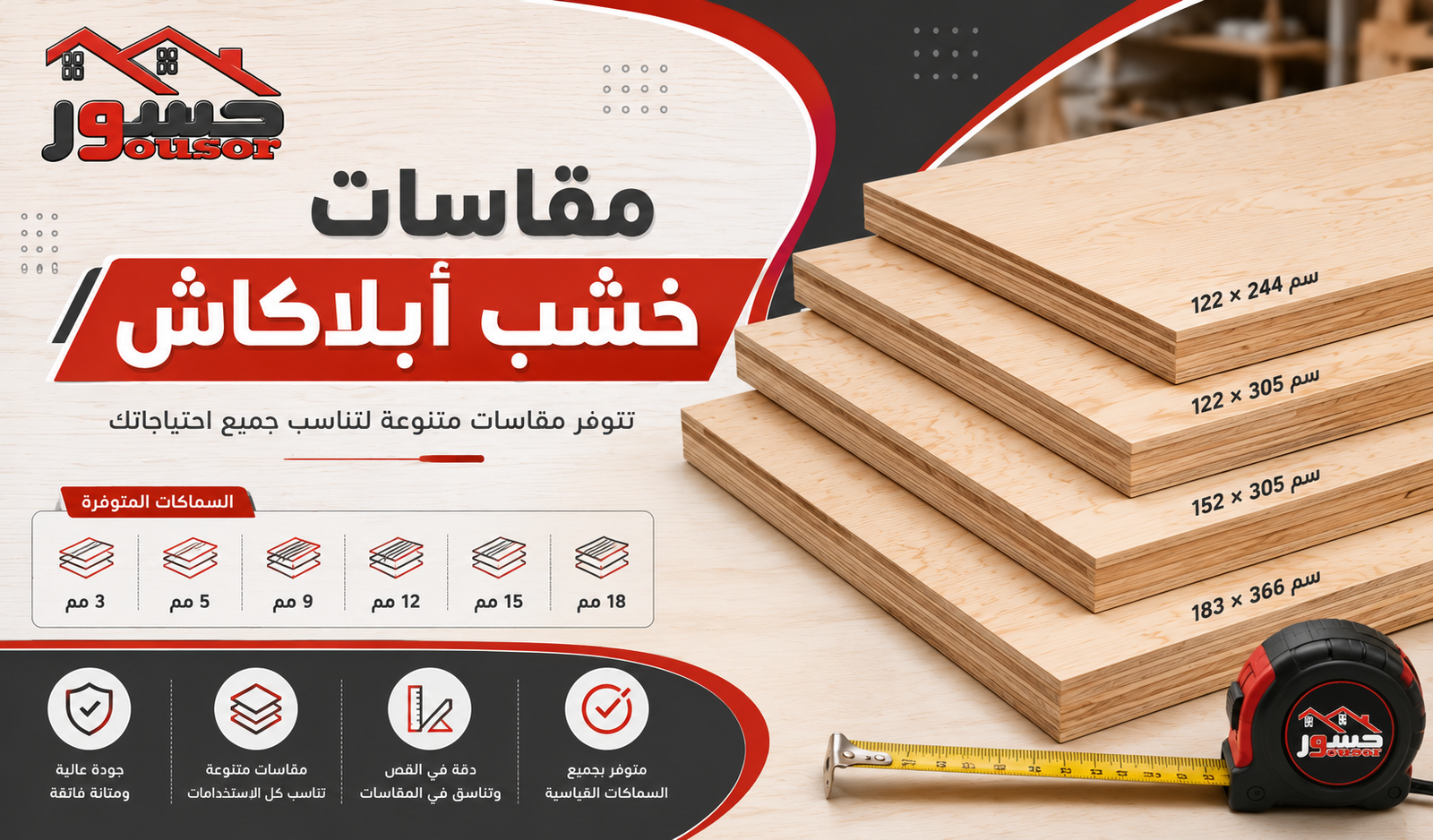
Plywood dimensions are among the most critical technical details that must be precisely determined before commencing any project; selecting the wrong size or thickness often goes unnoticed until after delivery and installation, at which point rectification becomes costly and time-consuming.
This challenge is further complicated by the varying standard sizes across different countries of origin—ranging from Korean to Indonesian panels—necessitating precise knowledge of the dimensions actually available in the market.
The major challenge facing contractors and engineers is the shortage of standard sizes or required thicknesses in local market warehouses—particularly during peak project periods, when demand for specific types intensifies.
In this article, we detail the available sizes and thicknesses and explain how to choose the most suitable options for your project, helping you avoid delays or waste caused by unavailability when needed.
What is the importance of knowing plywood dimensions before starting any project?
تحديد مقاسات خشب أبلاكاش بدقة قبل بدء التنفيذ يوفر على المشروع تكاليف إضافية ناتجة عن الهدر في القص أو إعادة التوريد لاحقًا.
Each application requires specific dimensions and thickness suited to the nature of the load and the target area; any error in this determination directly impacts the quality of the final execution.
Furthermore, knowing the sizes actually available in the market helps the engineer plan supply quantities in advance, rather than discovering a lack of availability midway through the execution phase.
Standard plywood sheet size on the market
The most widely used standard size for a plywood sheet is 122 x 244 cm; this is the size adopted by the majority of furniture and décor manufacturers due to its compatibility with common design dimensions in the market.
Other similar sizes are also available, such as 120×240 cm, which are frequently used in construction and general contracting applications.
Despite the prevalence of these two sizes, their actual availability in warehouses may vary depending on the country of origin and market demand during specific periods.
Available Plywood Thicknesses and Their Respective Applications
تتفاوت سماكات خشب الأبلاكاش بشكل واسع لتغطي احتياجات مختلفة، بدءًا من الألواح الرقيقة وحتى السماكات الإنشائية الثقيلة.
18mm Plywood Thickness and Its Structural Uses
18mm plywood is one of the most commonly used thicknesses for custom furniture and cabinet structures, as it can support weight without sagging while remaining easy to work with.
This thickness is also used for structural plywood partitions that require sufficient rigidity without excessive weight.
4mm laser-grade plywood for precision applications
4mm laser-grade plywood is designed for applications requiring high cutting precision, such as geometric patterns and intricate cut-out designs; its thin profile allows the laser head to move without resistance that might otherwise compromise cut quality.
This type is widely used in executing aesthetic designs that rely on fine details and intricate shapes.
Plywood sizes by country of origin
Plywood dimensions vary depending on the country of manufacture; therefore, it is necessary to verify the actual dimensions prior to supply to avoid any discrepancies with the design specifications.
Korean Plywood (Various Sizes)
Korean plywood is characterized by high manufacturing precision and a consistently maintained standard size of 122 x 244 cm, making it a reliable choice for projects requiring strict dimensional uniformity.
Indonesian plywood by the meter
Indonesian plywood is sometimes sold by the linear meter—offering buyers greater flexibility in determining quantities based on the project’s actual area—though its standard dimensions differ slightly from those of Korean-made plywood.
Plywood sheet dimensions compared to standard plywood sizes.
The dimensions of plywood sheets generally align with standard plywood sizes, as both typically rely on the 122 × 244 cm base size as a common industry standard.
However, the real difference lies in the available thicknesses and quality grades within each size; plywood, in the broad sense, encompasses a wider range of grades that vary in the consistency of their actual dimensions relative to the stated specifications.
To understand the subtle differences between the various grades, you can refer to the comprehensive guide to plywood types.
How do shortages of sizes and thicknesses in local market warehouses disrupt projects during peak periods?
Many contractors face a recurring challenge: the depletion of specific thicknesses or sizes from local market inventories—particularly during peak periods when demand for certain types surges unexpectedly due to the simultaneous execution of multiple major projects.
This shortage typically stems from multiple factors, most notably delayed import shipments or the reliance of some suppliers on limited inventory that fails to keep pace with high seasonal demand.
The consequences of this shortage are clearly evident in the site operations, as the execution teams find themselves facing two options, both entailing unplanned costs:
- Using a thickness or size alternative that does not match the original design, necessitating additional modifications during execution or procurement.
- Waiting for periods that can extend to weeks for the arrival of new shipments, which disrupts the schedule of the entire project.
Both options ultimately entail additional costs—whether directly through modifications to execution or indirectly through delayed delivery and the potential late-delivery penalties associated with certain contracts. To fundamentally avoid this scenario, it is advisable to adopt the following practices:
- Securing a prior agreement with a supplier ensures the continuous availability of essential sizes and thicknesses, rather than relying on ad-hoc purchasing at the time of actual need.
- تحديد كميات المشروع واحتياجاته من مقاسات خشب أبلاكاش في مرحلة التخطيط المبكرة، قبل بدء التنفيذ الفعلي بوقت كافٍ
- Inquiring about the supplier’s available inventory levels before entering into a contract, particularly during seasons of anticipated high demand.
How do you choose the right thickness for your project before procurement?
Selecting the appropriate thickness begins with determining the nature of the load to which the panel will be subjected; heavy-duty structural applications require greater thickness compared to lightweight decorative applications.
The intended end-use should also be considered—whether it involves furniture fabrication relying on conventional plywood applications, or a precision application requiring flexible plywood capable of being shaped into curves.
Finally, verifying the actual availability of the selected thickness with the supplier before approving the final design remains a necessary step to avoid any subsequent delays during implementation.
Frequently Asked Questions About Plywood Sizes
What is the standard size of a plywood sheet?
المقاس القياسي للوح الأبلاكاش هو 122×244 سم، وهو الأكثر انتشارًا في السوق، مع توفر مقاس قريب منه بأبعاد 120×240 سم The standard size for a plywood sheet is 122 × 244 cm—the most widely available size on the market—though a similar size of 120 × 240 cm is also available and used in certain construction applications.في بعض التطبيقات الإنشائية.
What thicknesses of plywood are available?
Plywood is available in a wide range of thicknesses, starting from 4 mm for precision applications up to 25 mm for heavy-duty structural uses, with the 18 mm thickness being one of the most commonly used for custom furniture making.
What is the suitable thickness for laser engraving?
4mm plywood is the ideal thickness for laser cutting; its thinness allows the laser head to move with high precision, free from resistance that might compromise cut quality, making it the perfect choice for geometric patterns and intricate cutout designs.
How do I choose the plywood thickness for the concrete pour?
The thickness of the plywood used for casting is selected based on the anticipated concrete pressure and the number of reuses; greater thicknesses—such as 18 mm or more—are preferred due to their ability to withstand repeated pressure without deformation or leakage during the pouring process.