


Blog
Uses of Plywood in the Kingdom’s Major Wood Industries

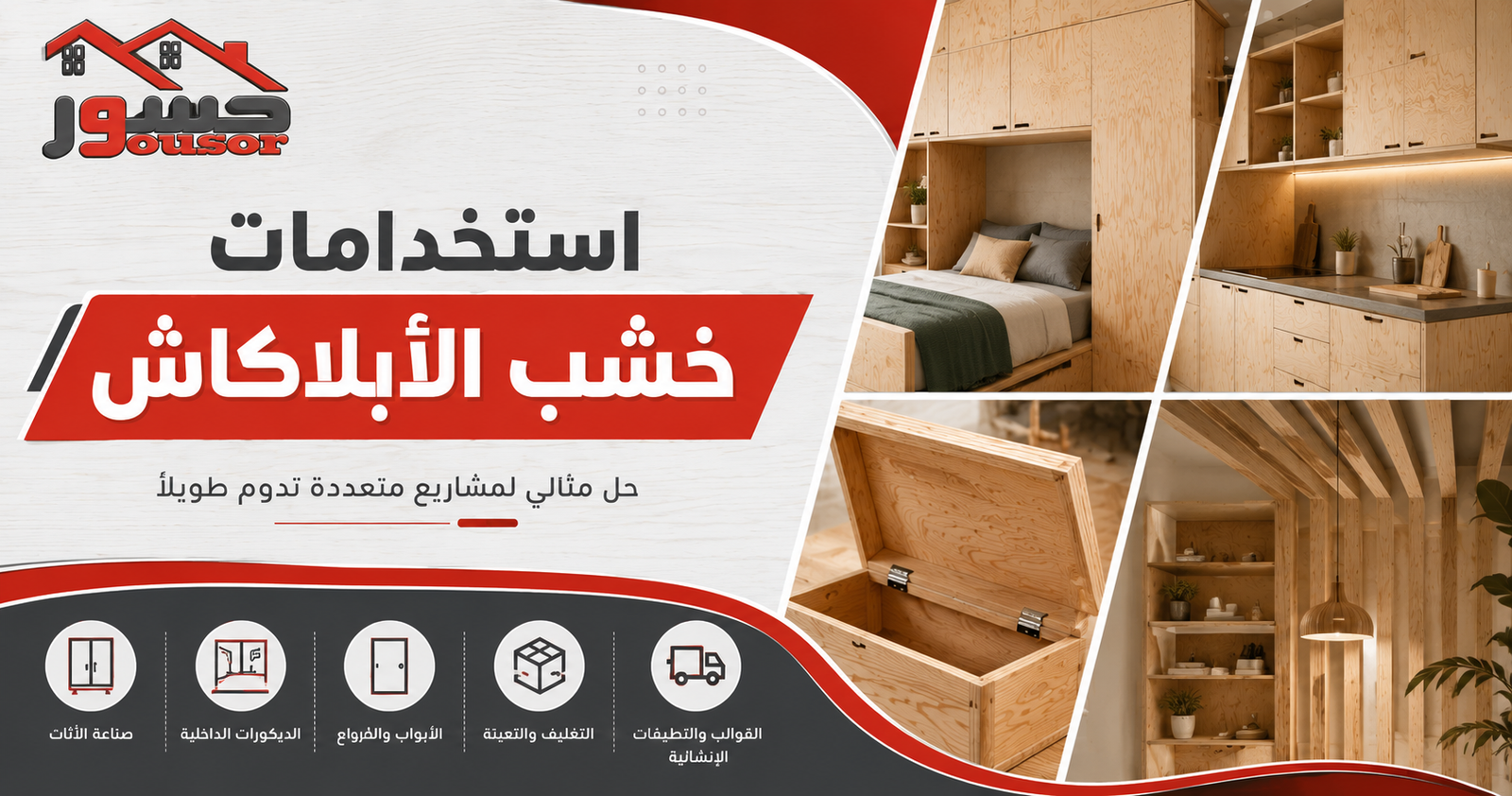
Today, the uses of plywood extend across a wide range, going beyond traditional furniture to include décor, structural partitions, and precision applications alike.
This widespread use makes it essential to understand exactly which thickness or type is suitable for each specific application; errors in this choice do not manifest immediately but rather emerge later in the form of deformations or reduced load-bearing capacity.
Many engineers and project owners fall into the trap of not knowing the most suitable thickness or type for a given application, resulting in direct financial waste on-site due to the need for re-supply or errors in execution.
In this article, we examine the key practical applications of plywood in detail, enabling you to make the right decision the first time—without the need for trial and error or the waste of project resources.
What makes plywood a popular choice for various applications?
The widespread popularity of plywood applications stems from its cross-laminated layered composition, which provides a rare balance between structural strength and light weight compared to solid wood.
This balance makes it adaptable to completely different applications, from precision furniture pieces to large structural partitions, without losing its stability or operational accuracy.
Since plywood varieties differ in thickness, type of adhesive, and degree of hardness, each application requires a carefully considered choice that takes into account the nature of the load and the surrounding environment.
Uses of Plywood in Custom Furniture and Bedroom Design
The uses of plywood in this field include multiple elements of furniture detailing and bedrooms, most notably:
- Custom-made plywood wardrobes featuring sturdy doors designed to withstand frequent opening and closing without sagging or warping.
- Manufacturing bed frames capable of withstanding heavy loads and continuous daily use.
- Manufacturing side units and nightstands as part of complete bedroom sets.
- Precision-crafted internal cabinet shelving allows for balanced load distribution.
- Manufacturing furniture fronts ready for painting or wrapping, according to the required design.
- Fabricating the fronts of cabinets and drawers that require a flat, warp-resistant surface.
- Manufacturing dressing tables and side desks for bedrooms.
- Preparing wooden mattress bases capable of supporting weight over long periods.
- Manufacturing inner cabinet drawers with clean edges to facilitate installation and operation
Uses of Plywood in Interior Decor and Finishing
The uses of plywood in this field encompass various elements of modern interior design, most notably:
- Installation of decorative plywood for suspended ceilings and unconventional aesthetic units.
- Preparing plywood wall backdrops that add a warm, aesthetic touch to spaces and are easy to install.
- Geometric laser-cut plywood designs featuring intricate patterns suitable for modern décor.
- Executing curved shapes and fluid designs using flexible plywood.
- Cladding decorative furniture facades with high-quality wood veneer layers.
- Manufacturing openwork decorative partitions that combine functionality with aesthetic appeal.
- Installation of raised flooring and decorative platforms for exhibitions and commercial spaces.
- Outfitting display fronts and suspended shelving within modern interior designs.
- Installation of concealed lighting and wooden recesses used in modern décor.
Uses of Plywood in Construction and Structural Partitioning
In this field, the uses of plywood are evident in various structural applications relied upon daily at work sites, most notably:
- Installation of plywood partitions to divide interior spaces without traditional construction work.
- Preparing the temporary wooden formwork during structural casting stages.
- Manufacturing wooden formwork capable of withstanding repeated concrete pressure.
- Installation of temporary protective flooring during construction stages on site.
- Preparing safety barriers and temporary partitions between different work areas.
- Installation of temporary protective panels for facades and openings during construction work.
- Outfitting guard rooms and temporary offices at project sites.
- Fabrication of temporary stairs and ramps to facilitate the movement of personnel and equipment on-site.
- Construction of external perimeter fencing around project sites currently under execution.
How does a lack of knowledge regarding the appropriate thickness or type lead to financial waste on the site?
Engineers often make the mistake of selecting insufficient thickness for an application bearing heavy loads, leading to the sagging or cracking of the element shortly after installation.
Conversely, a greater-than-necessary thickness might be selected for simple aesthetic applications, thereby increasing costs without any genuine technical justification.
This error in judgment is not limited to thickness alone but extends to the choice of the material type itself; using an economical board in a structural application that requires high moisture resistance leads to rapid deterioration and the need for complete replacement.
This disparity is largely due to a lack of precise knowledge regarding the differences between various types of plywood and the suitability of each for specific applications.
Practical experience shows that the various uses of plywood require a clear understanding of the characteristics of each type before supply, as an error at this stage results in direct financial waste in the form of repurchasing or dismantling what was previously installed and reinstalling it.
Therefore, advance planning and consulting a specialized supplier remain the most important steps to completely avoid this unnecessary cost.
When is plywood not the most suitable choice? And when should you turn to an alternative?
Despite the many uses of plywood, it is not the ideal solution in all cases; each application has its own characteristics that may be better suited to a material other than plywood itself.
For applications requiring an ultra-smooth surface ready for immediate painting—without the need for additional treatment—MDF is a more suitable choice due to the uniformity of its internal structure.
Projects requiring a ready-made finish without the need for additional painting find an ideal solution in melamine wood specifications, which provide a ready-to-use surface that saves both time and cost during execution.
To make a precise comparison between these options based on the specific application, it is advisable to review the differences between MDF and melamine, as well as the detailed uses of MDF, which clarify when one type outperforms the other.
For projects aiming for a luxurious, natural aesthetic that reflects the space’s high-end status, natural wood and Swedish wood remain options well worth considering before making a final decision.
Ultimately, the choice of the appropriate material is not based on a fixed preference, but rather on a careful analysis of the specific requirements of each project.
Frequently Asked Questions About Uses of Plywood
Is plywood used in making wardrobes?
Yes, plywood is widely used for custom-made wardrobes due to its ability to withstand repeated opening and closing and to securely hold hinges without edge crumbling or door sagging over time.
Is plywood suitable for screen backings?
Yes, plywood is perfectly suitable for creating plywood backdrop walls, as it provides a stable, lightweight surface that is easy to install and shape into various forms to suit the backdrop design.
How is plywood used in construction?
In construction, plywood is primarily used to create partitions for dividing spaces, construct temporary formwork for concrete casting, and fabricate molds capable of withstanding repeated concrete pressure.
Is plywood safe for children’s rooms?
Plywood is considered safe for children’s rooms when selecting a type that meets standards for zero harmful emissions, while also ensuring the appropriate thickness and grade to guarantee the piece’s stability and the absence of sharp or unfinished edges.