

Blog
Uses of MDF in outfitting offices, hotels, and large-scale facilities.

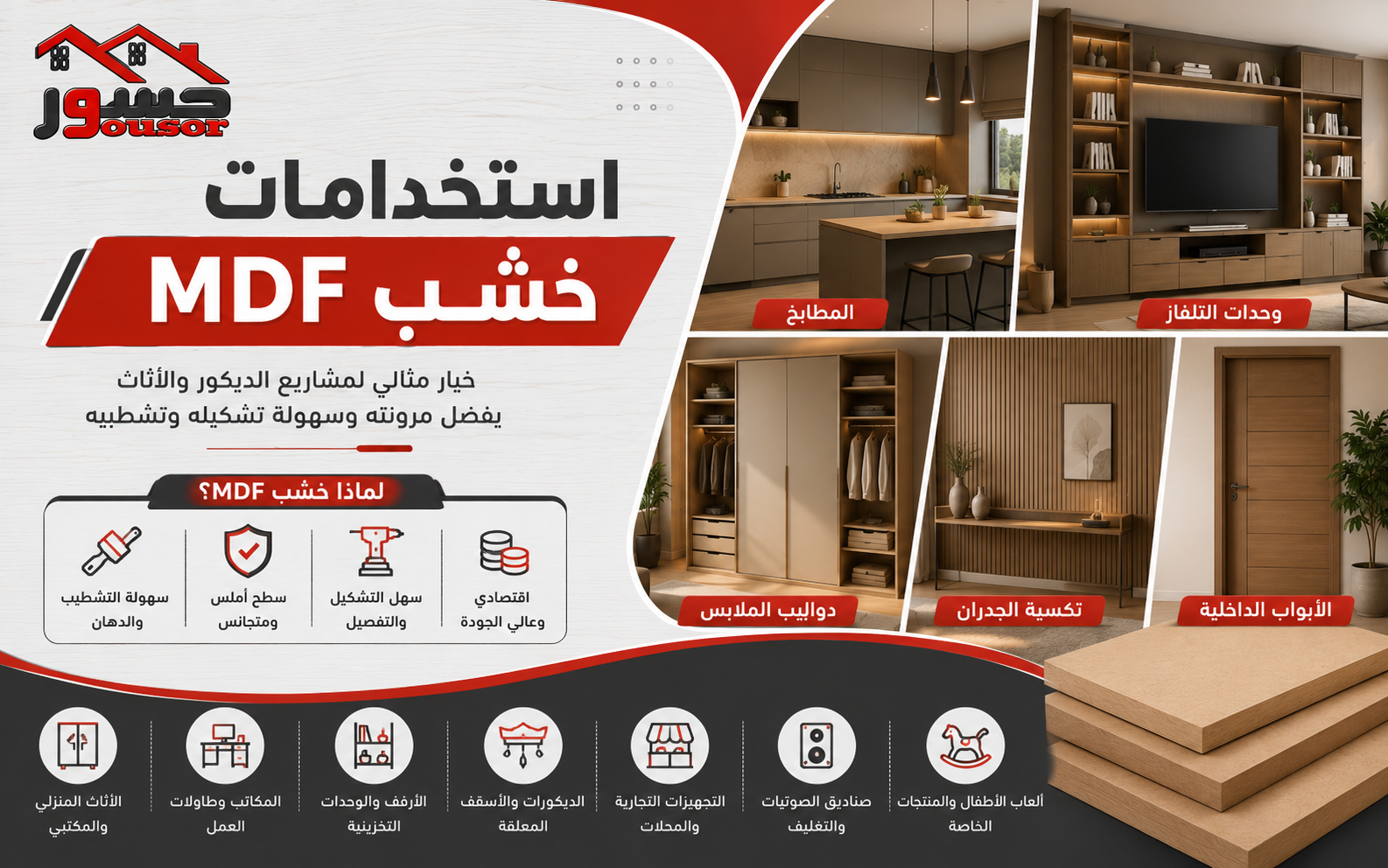
The uses of MDF today span a wide range of applications, from custom home furniture to wall décor and specialized interior finishes.
This widespread adoption is attributed to the material’s uniformity and the ease with which it can be shaped with high precision, making it a practical choice that serves multiple purposes without the need to change the base material from one application to another.
However, each application requires a precise understanding of the material’s suitability; while it excels in certain interior applications, its effectiveness remains limited in others, such as outdoor uses exposed to the elements.
In this article, we examine the key practical applications of MDF in detail and outline the limitations of its use, enabling you to make the right decision when selecting the appropriate material for your project.
What makes MDF an ideal material for versatility?
The versatility of MDF is due to several key reasons, most notably:
- Uniformity of the internal structure, free from knots or voids.
- Easy to cut and shape with high precision, without cracking or crumbling at the edges.
- Highly suitable for finishing with paint, melamine, or natural veneer.
- Good dimensional stability reduces expansion or contraction with changes in humidity.
- Its suitability for applications requiring precise measurements, ranging from small furniture pieces to large wall units.
Uses of MDF in Custom Home Furniture
The uses of MDF in this context vary, encompassing key elements of home furniture, most notably:
- Custom-made MDF bedroom sets featuring wardrobes, beds, and side units with an elegant finish.
- Manufacturing MDF tables for living and dining rooms, featuring stable surfaces that do not warp with use.
- Fabricating TV units with diverse designs that combine durability with aesthetic flexibility.
- Manufacturing home offices with diverse finishes to suit various workspaces.
Uses of MDF in décor and interior finishes
The uses of MDF in these finishes extend to cover various elements of interior design, most notably:
- Installation of MDF wall cladding to conceal underlying wall imperfections and create a uniform aesthetic appeal.
- Preparing wooden boards for shelves in bookcases and wall-mounted storage units.
- Installation of multi-level suspended ceilings.
- Manufacturing hollow decorative units featuring intricate architectural patterns and details.
Uses of MDF in kitchens
MDF is used in various kitchen applications, most notably:
- Manufacturing internal cabinet structures using a stable and easily formable material.
- Fabricating drawer fronts using moisture-resistant material to minimize the risk of swelling.
- Equipping the internal shelf surfaces of the cabinets with a flat, easy-to-clean surface.
- Manufacturing additional storage units, such as spice cabinets and side spice racks.
Uses of MDF in commercial and office projects
The use of MDF is expanding within the commercial and office sectors to encompass a wide range of applications suited to diverse work environments, most notably:
- Manufacturing reception desks and front-facing units with elegant finishes that reflect the facility’s identity.
- Setting up display shelves and promotional storefronts in retail stores and exhibitions.
- Installation of office partitions that divide the workspace without completely blocking visibility.
- Manufacturing conference tables and office storage units with unified designs that align with the company’s identity.
- Setting up temporary display booths at trade shows and commercial events, due to their low cost and ease of dismantling.
The difference between using raw MDF and melamine MDF based on the application.
The difference between using raw MDF and melamine MDF based on the application.
- Raw MDF is used in applications requiring a custom finish—such as specific paint colors or natural veneer wrapping—including high-end furniture or designs that demand a fully personalized touch.
- Melamine MDF is used in applications requiring a quick, uniform finish without additional cost, such as interior cabinetry and shelving that is not fully visible.
- For visible elements such as kitchen fronts and office furniture, melamine MDF is often preferred for providing a uniform, low-maintenance finish.
- For elements requiring a bespoke, luxurious feel—such as wall décor or furniture with exclusive designs—raw MDF that is painted or finished with natural veneer remains the most suitable choice.
- From an economic perspective, melamine MDF offers a faster and more cost-effective solution for projects requiring the rapid execution of a large number of identical units.
Is MDF suitable for outdoor use?
MDF is generally not a suitable choice for exposed outdoor applications, as direct exposure to sunlight, rain, and temperature fluctuations leads to the gradual deterioration of its fibrous structure—even in moisture-resistant varieties.
While the moisture-resistant green variety can withstand occasional exposure to steam or spills, it does not meet the level of resistance required for outdoor environments exposed to the elements across the changing seasons.
Therefore, it is advisable to limit the use of MDF to interior or semi-protected applications—avoiding exterior facades or elements directly exposed to the elements—and instead opt for materials specifically designed to withstand such conditions.
Drawbacks of MDF that limit some of its uses
The drawbacks of MDF limit its suitability for certain applications; among the most notable of these drawbacks are:
- It is relatively heavy compared to other types of wood, necessitating additional structural reinforcement for large-sized pieces.
- The high moisture sensitivity of the untreated standard grade limits its use in humid or outdoor environments.
- Poor nail and screw holding capacity during repeated fastening and removal.
- Difficulty of localized repair in the event of a break or damage, as it often requires replacing the entire part.
How do you treat the edges and ends of MDF before installation?
Treating MDF edges and ends prior to installation requires following specific steps to ensure the piece’s durability and protect it from damage, most notably:
- Applying a filler layer to the cut edges to seal fine pores prior to any subsequent finishing.
- Using melamine or natural veneer edge banding to cover exposed edges and protect them from moisture.
- Sand the edges thoroughly after applying the tape to ensure a smooth finish without visible ridges.
- Apply a suitable primer before the final coat to ensure better adhesion and reduce edge absorption of the paint.
- Ensure all edges are completely sealed, leaving no part exposed—especially on components frequently exposed to water.
Frequently Asked Questions About the Uses of MDF
Is MDF suitable for custom-made bedrooms?
Yes, MDF is perfectly suitable for custom bedroom furniture; it provides a stable surface for crafting wardrobes, beds, and side units with a sleek finish, and can be painted or laminated with melamine to suit the desired design.
How is MDF used for wall cladding?
MDF is used for wall cladding by cutting it into panels or geometric shapes that are mounted directly onto the wall; this conceals underlying imperfections and gives the space a uniform, aesthetic appearance, while allowing for the addition of patterns or raised details depending on the design.
Is it used for exterior décor?
Using MDF for exposed outdoor décor is not recommended—even the moisture-resistant variety—as direct exposure to sunlight and rain gradually damages its fibrous structure. It is best to limit its use to indoor or semi-protected applications.
What is the best way to finish MDF edges?
The best way to finish MDF edges is to apply melamine or natural veneer edge banding—after first applying a sealer to the edge and sanding it thoroughly—to ensure a smooth finish and complete protection against moisture.
For more related articles:
The-difference between MDF and melamine.