

Blog
The Difference Between MDF and Melamine: Which Is Best for Your Commercial Projects?

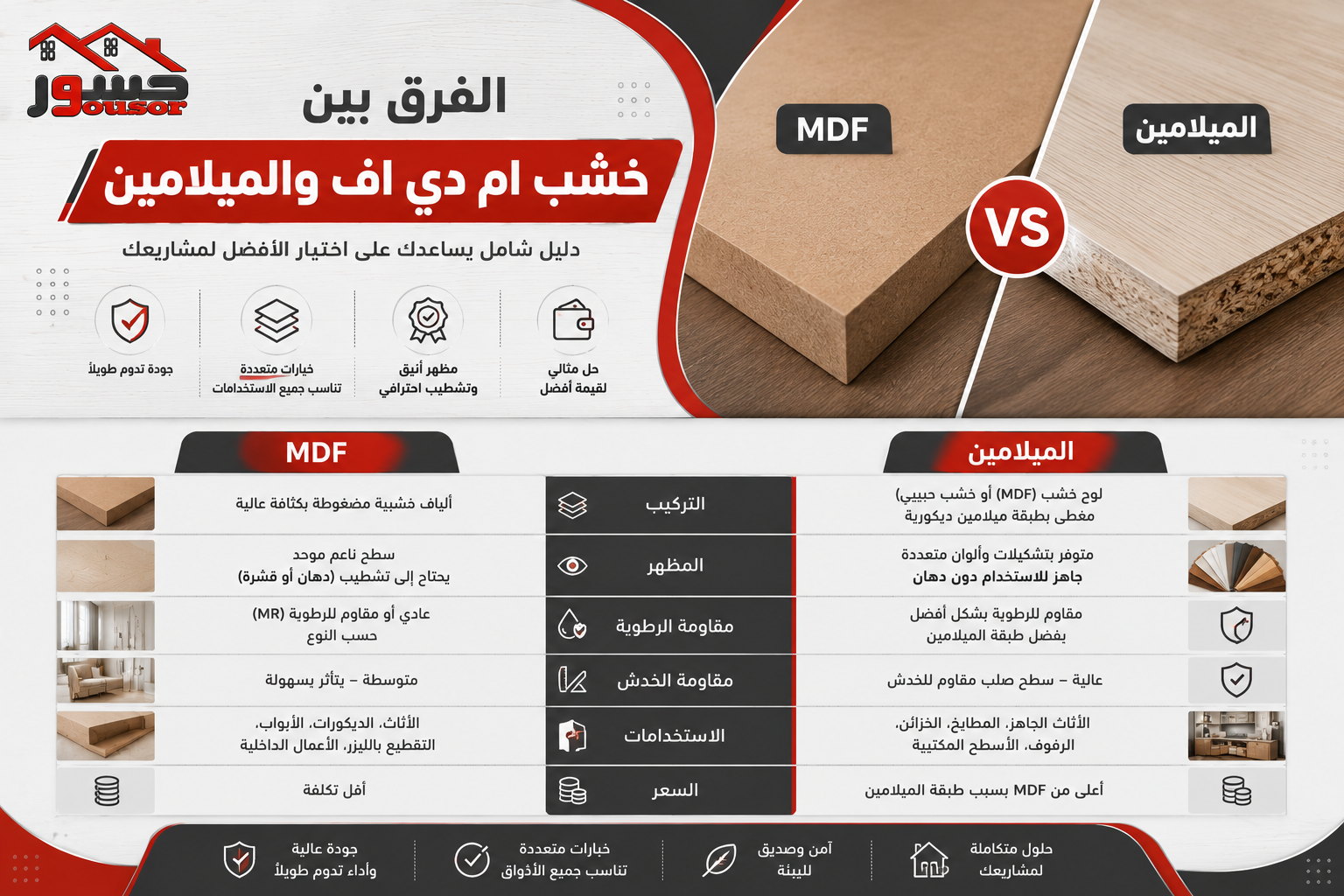
Understanding the difference between MDF and melamine is a common question for anyone preparing to undertake a furniture project or fit out a new kitchen; many people confuse the two terms, even though they refer to concepts that differ completely in terms of composition and function.
While MDF is a type of engineered wood in its own right, melamine is an exterior finish applied to various types of boards; consequently, comparing the two requires a precise understanding before making a purchasing decision.
In this article, we explain the fundamental differences between the two materials in terms of performance, durability, and price, enabling you to choose the most suitable option for your project—whether it involves a kitchen, office furniture, or home furnishings.
What is the difference between MDF and melamine in terms of their basic composition?
The difference between MDF and melamine lies in the fundamental nature of each; this can be explained in the following points:
- MDF is a type of engineered wood manufactured from fine wood fibers mixed with resin under high pressure and heat.
- Melamine is not a type of wood; rather, it is an exterior finish applied to the surface of a wooden board (often MDF or particleboard) to protect and enhance it.
- MDF board can come raw, without any covering layer, whereas melamine board always comes with a ready-made finish.
- The melamine layer determines the board’s final appearance (color, texture, and gloss), while the type of MDF used beneath it determines the piece’s structural performance.
Key characteristics of MDF that make it advantageous for manufacturing
MDF offers numerous advantages that make it a preferred choice in manufacturing, most notably:
- A perfectly uniform surface, free from the knots or voids that characterize natural wood.
- Easy to cut and shape with high precision and without cracking, enabling the execution of complex designs.
- Highly suitable for painting and finishing with various types of coatings and veneers.
- Good dimensional stability reduces shrinkage or expansion when ambient humidity changes.
- Reasonable production cost compared to natural wood, with comparable functional performance in many applications.
Types of MDF Wood
The main types of MDF available on the market:
- Malaysian MDF — characterized by consistent density and stable specifications, making it one of the most sought-after types for general furniture.
- Colored MDF boards — featuring a uniform color finish, ready for immediate installation without the need for additional painting.
- Moisture-resistant MDF (green) — specially treated to reduce water absorption by the fibers; suitable for kitchens and bathrooms.
- High-gloss MDF — featuring a sleek, reflective surface suitable for modern kitchen fronts and luxury furniture.
- Natural veneer MDF — covered with a genuine wood veneer that gives it a warm, authentic wood appearance.
- Standard (raw) type — natural, untreated brown; used as a base for the subsequent application of paint or melamine.
Properties of melamine wood and the nature of its outer layer
Melamine wood is characterized by several features suited to the nature of young children, most notably:
- A relatively hard surface layer resistant to light surface scratches compared to uncoated wood.
- A final finish ready for immediate use, requiring no additional painting or coating stages.
- A wide variety of colors, patterns, and textures, including imitations of the look of natural wood or marble.
- Easy to clean and maintain on a daily basis, thanks to the relatively non-porous surface texture.
- The layer adheres directly to the base board without adding significant thickness to the overall dimensions.
Drawbacks of Melamine Wood to Know Before Choosing
Despite its advantages, the drawbacks of melamine wood involve important points to consider before making a choice, most notably:
- Prone to peeling or separating from the base board when exposed to severe moisture or strong impacts on the edges.
- Difficulty of spot repair in the event of deep scratches or damage, as it cannot be sanded or restored like natural wood.
- Susceptibility of poorly sealed edges to swelling upon repeated contact with water.
- Limited scope for subsequent modification or refinishing; once the layer has bonded, changing the color or texture is difficult without replacing the entire panel.
Long-term durability of MDF compared to melamine
The durability of MDF versus melamine varies depending on the perspective from which the comparison is made; in reality, the two are not equivalent alternatives, but rather elements that are often interconnected.
In terms of internal structural performance, the stability of the piece depends on the quality of the MDF board itself, regardless of whether or not a melamine layer is present; melamine does not add any significant structural strength to the board, serving instead only to provide surface protection and aesthetic appeal.
As for the exterior surface, the melamine-faced board excels in resisting everyday scratches and fading caused by light exposure, unlike raw or painted MDF, which may require periodic repainting.
However, this superficial advantage of melamine diminishes upon exposure to high humidity or impacts on the edges, as it becomes prone to peeling—unlike painted surfaces, which can be repaired relatively more easily.
Which is better for kitchens: MDF or melamine?
When comparing MDF and melamine to determine which is better for kitchens, the precise answer depends on how each material is used within the kitchen, rather than on a general preference for one over the other.
For concealed internal cabinet structures, melamine is a practical and cost-effective choice, given its ready availability and ease of cleaning without the need for additional finishing.
As for exterior surfaces requiring greater resistance to constant moisture—such as areas near the sink—a moisture-resistant type of MDF with a high-quality paint finish or veneer may be a safer long-term choice.
In the vast majority of modern kitchens, the optimal solution actually involves combining the two: an MDF board as the structural base, covered with a melamine layer as the final finish—thereby combining the durability of the base with the easy maintenance of the surface.
The price difference between a raw MDF board and a melamine board.
Raw MDF is generally less expensive to purchase initially than ready-made melamine board; however, a precise comparison between the two materials requires considering the following points:
- Raw MDF board does not undergo any additional covering or finishing stage during manufacturing, which makes its base price lower than that of melamine board.
- The price of a melamine board includes the cost of the final, ready-to-use finish, as it leaves the factory with a complete surface coating that requires no further treatment.
- Raw MDF board requires additional post-processing costs—such as painting or lamination—to make it suitable for visible end-use applications.
- The low initial price of raw MDF may not reflect the actual total cost once subsequent finishing stages are taken into account.
- The final total cost of MDF after finishing may approach—or sometimes even exceed—the price of a ready-made melamine board, especially when high-precision finishes or high-quality natural veneers are specified.
How do you choose the most suitable material based on the nature of your project?
Selecting the most suitable material depends on clearly defining several factors related to the nature of the project and its actual requirements:
- Determining whether the component is exposed—requiring a direct aesthetic finish—or concealed, where structural performance alone suffices.
- Assess the level of moisture exposure at the installation site to select a moisture-resistant type if necessary.
- Adhere to the available budget, taking into account the total cost—including finishing—rather than just the price of the raw board.
- Reviewing melamine wood specifications to ensure the available colors and patterns are suitable for the project design.
- Consult a guide on MDF applications to determine the best use for each type before making a final decision.
Frequently Asked Questions About the Difference Between MDF and Melamine
Which is better for kitchens: MDF or melamine?
The choice depends on the location of use; melamine is suitable for concealed interior cabinets due to its ease of cleaning, whereas moisture-resistant MDF—finished with a high-quality coating or veneer—is preferred for exterior surfaces near water sources. A combination of both is often used to achieve the best result.
Does the melamine layer protect the wood from water?
The melamine layer offers good resistance to incidental moisture and surface spills; however, it does not provide complete protection against water—particularly at poorly sealed edges or with prolonged exposure to high humidity—which can eventually lead to peeling or swelling.
What is the price difference between raw material and melamine?
Raw MDF is less expensive to purchase initially but incurs additional costs for painting or surfacing. Melamine board comes with a ready-made finish included in the price, so the total cost of both options may end up being comparable once the full finishing stages are factored in.
How do I choose the most suitable material for office furnishing?
First, determine the item’s visibility and the extent of its daily use; melamine is suitable for visible surfaces requiring easy cleaning and a uniform appearance, whereas painted or natural veneer-clad MDF is ideal for pieces requiring a luxurious, custom look.