

Blog
Advantages of Swedish Red Wood in Saudi Construction and Carpentry Projects

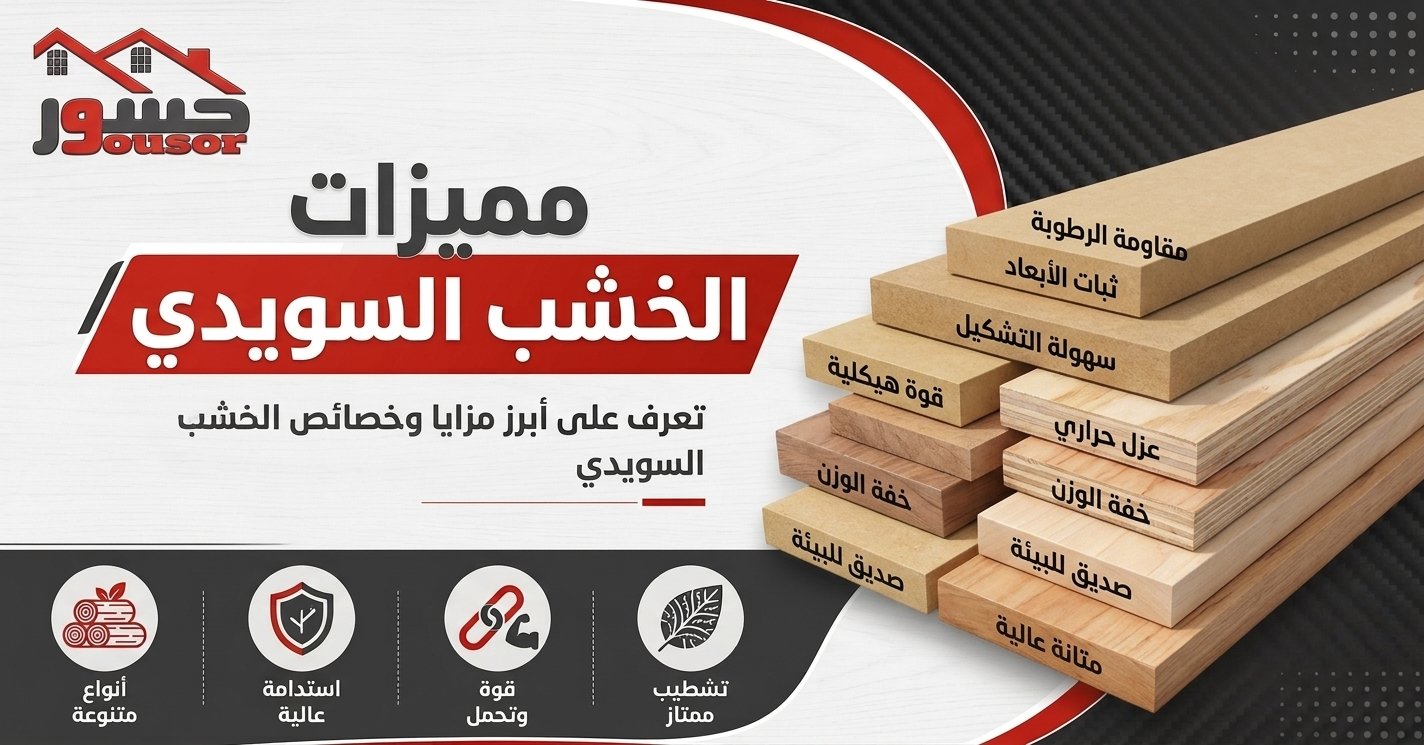
The qualities of Swedish red wood have made it a firmly established choice in Saudi construction and carpentry, thanks to its rare balance of competitive pricing and structural quality capable of withstanding intensive daily use.
However, many contractors on-site encounter the problem of “malicious knots” in commercial-grade timber boards—hidden defects that lead to wood decay or breakage shortly after installation.
In this article from Jusoor Timber, we explain how to avoid this issue, while also examining the moisture resistance of Swedish timber and its key practical applications—offering a reliable and cost-effective solution.
What are the key advantages of Swedish wood in carpentry and construction work?
Swedish wood offers numerous advantages that have made it a well-established choice in the Saudi market, most notably:
- A perfect balance between competitive price and construction quality, making it an economical choice without sacrificing durability.
- Ease of cutting, operating, and finishing, which reduces execution time in carpentry workshops.
- Relatively good dimensional stability reduces panel curvature or warping over time.
- Widely available in the local market in multiple sizes and thicknesses to meet various project needs
- Good paintability and coloring properties, allowing it to be coordinated with various interior designs.
The risk of malignant nodules in commercial panels and their effect on decay and breakage
Malicious nodules are one of the most common problems in low-grade commercial boards, as they result from the growth sites of branches inside the tree trunk and appear as dark, inconsistent spots whose composition differs from the surrounding wood.
The danger of these knots lies in the fact that they are real structural weaknesses, as they lose their attachment to the surrounding wood fibers over time, making them prone to falling off or breaking when the board is subjected to direct pressure or load at the execution site.
كما تشكل هذه العقد بيئة مثالية لتجمع الرطوبة والعفن، وهو ما يسرّع من عملية التسوس مقارنة بالمناطق السليمة من اللوح، خاصة في حال عدم معالجتها أو تغليفها بشكل صحيح قبل الاستخدام.
For this reason, sorting the slabs and checking that they are free of harmful knots, or at least ensuring that they are small and cohesive, is an essential step before approving any supply batch for projects that require reliable structural performance.
Is Swedish wood susceptible to decay?
Yes, Swedish wood can be susceptible to decay, but the likelihood of this is directly related to the quality of the original sorting of the board and the presence of malignant knots or internal cracks that were not visible at the time of purchase.
High-grade boards that are free from these defects have relatively good resistance to decay, especially when stored properly away from direct contact with ground moisture or poor ventilation.
In contrast, low-quality commercial panels, which often contain malicious knots or areas of poor cohesion, are more likely to absorb moisture and begin the process of decay from within before signs appear on the outer surface.
To reduce this risk, it is advisable to treat the wood with a dedicated protective material before installation, along with dealing with a supplier that ensures accurate sorting of boards free from hidden defects.
Swedish wood’s resistance to moisture in Saudi Arabian climates
Swedish wood has moderate resistance to moisture, which is sufficient for normal indoor uses in the Saudi climate, but it remains below the required level of resistance in highly humid environments or direct, continuous exposure to water.
In areas with high relative humidity, such as coastal areas, this type of wood needs additional treatment with specialized protective materials that reduce moisture absorption and limit the risk of expansion or warping resulting from frequent weather changes.
In the dry and hot regions of the Kingdom, the biggest challenge lies not in humidity but in the sharp temperature fluctuations between day and night, which necessitates choosing well-sorted and dimensionally stable panels to reduce the possibility of cracking.
Therefore, it is always advisable to match the type of treatment required with the nature of the geographical area of the project, rather than relying on a uniform treatment that does not take into account the difference in climatic conditions between the cities of the Kingdom.
Disadvantages of Swedish wood that you should know before buying
Despite its many advantages, Swedish wood has some important drawbacks that should be considered before making a purchase decision, most notably:
- The likelihood of malignant nodes being present in low-grade commercial slabs weakens their structural integrity over time.
- Only moderate resistance to moisture; additional treatment is required in humid environments or those exposed to direct water.
- Quality variations between different batches occur when dealing with unreliable suppliers who do not adhere to strict sorting procedures.
- Prone to warping or cracking when stored improperly and away from adequate ventilation.
- It is relatively less hard compared to some other premium natural woods, which limits its use in very heavy-duty applications.
Natural pine wood vs. Swedish wood: Which is more suitable for your project?
Natural pine wood differs from Swedish wood in several aspects that affect the choice decision according to the nature of each project.
In terms of density and stiffness, pine tends to offer relatively higher structural performance in some applications, while Swedish wood maintains a clear advantage in terms of the balance between price and quality, making it a more economical choice in large-scale projects.
In terms of availability, Swedish wood has wider distribution in the Saudi market with a relatively stable supply, while pine wood may face variations in availability depending on the source of import and the season of demand.
In general, Swedish wood remains the most suitable option for projects seeking a practical balance between cost and quality, while pine wood is preferred in specialized applications that require specific structural properties not provided by the first alternative with the same efficiency. For more details on other options within the types of natural wood available in the market, refer to the comprehensive guide to these types.
Uses of Swedish wood in carpentry and contracting
Swedish wood has a wide range of uses in this field, including multiple applications, most notably:
- The internal structures of the seating pieces are manufactured using Swedish wood for sofas, due to its light weight and ease of shaping.
- Custom-made Swedish wood doors for interior rooms with a good balance between durability and cost
- Preparing temporary wooden formwork at construction sites
- Manufacturing affordable mid-budget office furniture
- Manufacturing internal frames for upholstered furniture that require lightness and ease of operation rather than high rigidity.
Is Swedish suitable for entrance doors?
Swedish wood is well suited for interior room doors, but it is not the ideal choice for main entrance doors that are directly exposed to sunlight and harsh weather conditions throughout the year.
Its nature as a relatively soft wood, despite its good structural durability, makes it more prone to expansion and contraction when directly exposed to fluctuations in external temperature and humidity compared to harder woods such as luxurious teak.
ولذلك، في حال الرغبة باستخدامه لباب مدخل رئيسي، يُنصح بمعالجته جيدًا بطبقات حماية مخصصة ضد الأشعة فوق البنفسجية والرطوبة، أو تركيبه في مواقع محمية جزئيًا كالمداخل المظللة، بدلًا من التعرض الكامل والمباشر لأشعة الشمس طوال اليوم.
Swedish wood prices in Saudi Arabia and the factors that determine them
The price of Swedish wood in Saudi Arabia varies depending on several key factors that determine the final cost per meter or sheet:
- Size and thickness: Larger sizes or thicker woods command a higher price due to the increased quantity of raw material used.
- Sorting and quality grade: Boards free of harmful knots and classified as high-grade sorted are priced higher than economy commercial grades.
- Degree of treatment: Kiln-dried or insect- and moisture-resistant wood incurs an additional cost compared to untreated wood.
- Order volume: Projects requiring large quantities may receive preferential pricing when contracting directly with a supplier rather than purchasing in installments.
- Import market fluctuations: Since this type is entirely imported, global shipping costs and currency exchange rate fluctuations directly affect the final price in the local market.
What is the current price per meter of Swedish wood?
يشهد سعر متر الخشب السويدي في السوق السعودي تفاوتًا ملحوظًا بين مورد وآخر، ويعتمد بشكل مباشر على المقاس والسماكة ودرجة الفرز المطلوبة، فضلًا عن كون هذا الخشب مستوردًا بالكامل ومرتبطًا بتقلبات أسعار الشحن العالمية وصرف العملة.
Given this ongoing variance which makes any fixed number inaccurate in the medium term, the most reliable way to find out the current actual price is to request a direct quote from a specialist supplier, clearly specifying the size, thickness and sorting grade required to ensure pricing that reflects the actual project specifications.
For more related articles: