


Blog
Technical specifications of melamine wood

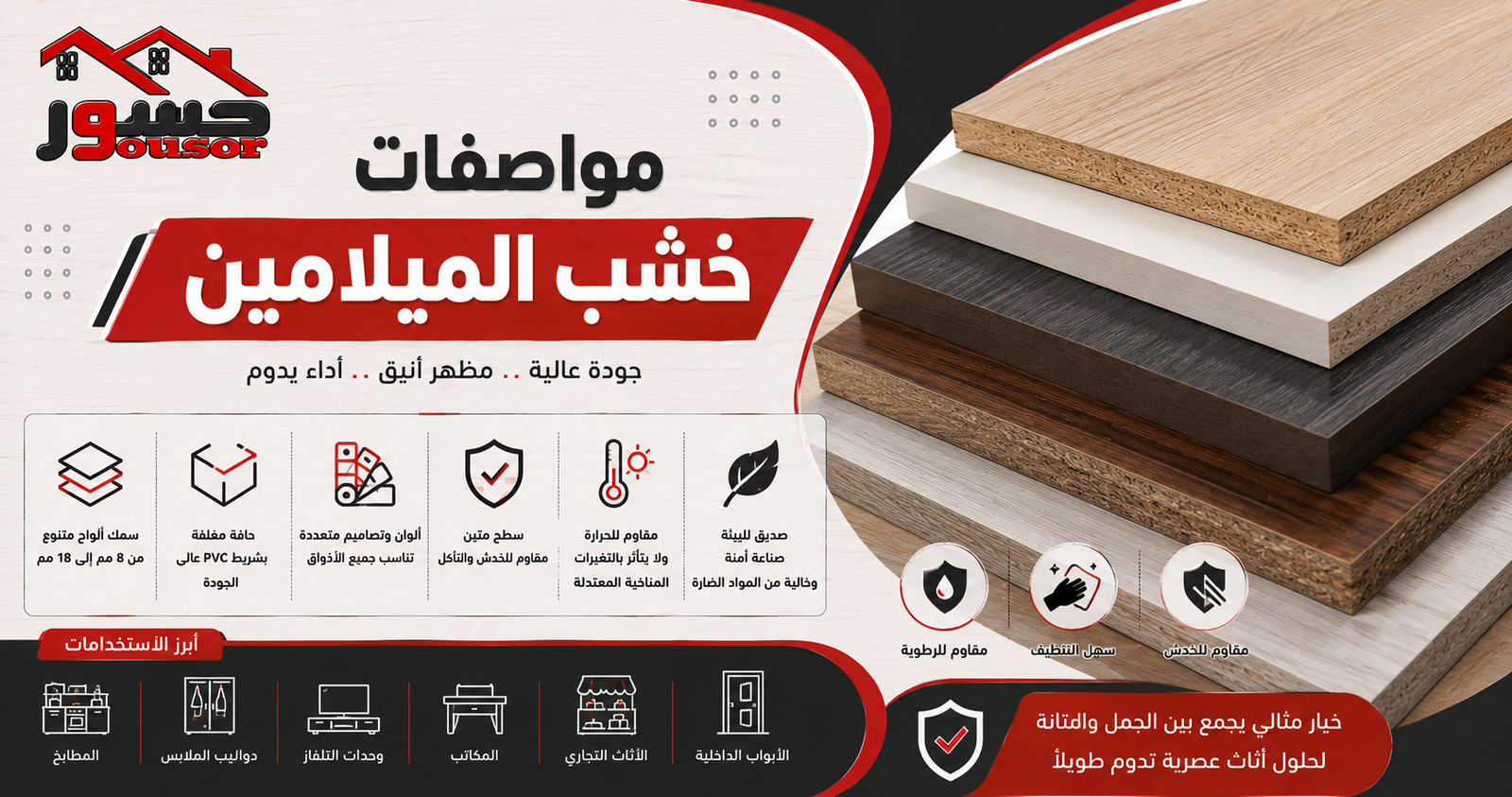
The specifications for melamine wood used in modern furniture production lines allow for no margin of error; they precisely define the standards for density, thickness, and abrasion resistance that every board must meet before entering the manufacturing stage.
Many furniture manufacturers face a recurring challenge involving color fading and the susceptibility of exterior surfaces to scratching, as well as density levels that fail to meet approved specifications—issues that directly impact the durability of the final product.
In this article, we rigorously examine the technical specifications required for every melamine board, ensuring the selection of a material that meets professional production standards.
Globally approved specifications for melamine wood
Globally recognized specifications for melamine-faced wood encompass a set of rigorous technical standards that the board must meet before being approved for professional production lines, most notably:
- A uniform standard density for the base layer ensures structural stability that remains unaffected by repeated use.
- The thickness of the outer melamine layer shall be no less than the approved minimum to ensure adequate abrasion resistance.
- High color fastness under continuous light exposure, without noticeable fading.
- Certified scratch resistance based on standard abrasion tests, such as the European Taber Abrasion test.
- Complete adhesion between the melamine layer and the base board, without any gaps or air bubbles.
- Compliance of dimensions and thickness with the declared specifications, without deviation exceeding the permitted margin.
Verifying that all these criteria are met—rather than just some of them—remains the true deciding factor distinguishing a genuinely compliant board from one marketed under the same name without a genuine commitment to quality.
The Density of Melamine Boards and Its Role in Determining Actual Quality
The density of melamine boards is the primary and most accurate indicator of a board’s actual quality, as it is directly linked to the board’s load-bearing capacity and long-term wear resistance.
A low-density board—even if it appears identical in terms of appearance—loses its ability to securely hold nails and screws and becomes more prone to bending under sustained loads.
Since this factor cannot be distinguished by visual inspection alone, dealing with a reliable supplier that provides certified density certificates is a necessity rather than an option—particularly when sourcing large quantities for continuous production lines.
It is worth noting that the density of a melamine board typically depends on the quality of the core board used beneath the outer layer—whether it is high-density MDF or lower-quality particleboard.
Melamine-faced wood thickness and standard production line dimensions
Melamine-faced wood panels are available on the market in a range of standard thicknesses suitable for various modern furniture production applications; the most prominent standard thicknesses are:
- 3 mm — Used for thin back panels and non-load-bearing decorative cladding.
- 6 mm — Suitable for internal drawers and lightweight partitions.
- 9 mm — used for cabinet backs and non-load-bearing components.
- 12 mm — a common thickness for internal shelves and intermediate units.
- 15 mm — Used for drawer fronts and doors requiring moderate durability.
- 18 mm — Most commonly used for main cabinet structures and load-bearing furniture fronts.
- 25 mm — Used for desktop surfaces and units requiring high rigidity.
- 32 mm and above — used for heavy-duty structural surfaces and bases for heavy-duty commercial furniture.
As for standard panel sizes, most production lines adhere to the following dimensions:
- 122 × 244 cm — The most widely used standard size, both globally and locally.
- 120 × 240 cm — a common alternative size in some local production lines.
- 183 × 366 cm — a large size used in extensive commercial projects to minimize the number of visible joints.
Adherence to these standard thicknesses and dimensions remains a fundamental criterion when contracting with any supplier, as any deviation from the declared specifications directly impacts manufacturing precision and waste rates during cutting. To accurately compare these thicknesses against specific application requirements, it is advisable to review the differences between MDF and melamine; this helps determine the appropriate thickness based on the intended end-use of the piece.
Scratch-resistant melamine panels: Technical standard for the outer surface
The classification of scratch-resistant melamine panels is subject to rigorous technical standards that measure the outer surface’s resistance to repeated friction—a critical criterion for heavy-duty applications such as office surfaces and wooden flooring.
This standard relies on the thickness of the outer protective layer (overlay) and the quality of the resin used in its manufacture; boards that meet these specifications effectively maintain their surface integrity for many years, showing no visible scratches even under heavy daily use.
This performance is measured globally using the Taber Abrasion test, with panels classified into varying resistance grades (from AC1 to AC5); higher grades are designated for heavy-duty commercial use, while intermediate grades suffice for standard residential use.
This criterion remains particularly crucial when combining melamine with MDF in commercial and office environments, where frequent use demands a higher level of resistance than is typical for residential settings.
Oak-effect melamine finishes and the latest designs in the Saudi market.
Oak-patterned melamine tops the list of most sought-after designs in the Saudi market, thanks to its combination of a warm, natural look and versatility in complementing various modern and classic décor styles alike.
This pattern is available in a variety of shades, ranging from light oak with a Scandinavian feel to dark oak, which lends spaces a luxurious and more formal character.
The Saudi market is also seeing growing demand for embossed textures that replicate the details of natural wood—offering a tactile experience rather than just a visual one—alongside marble patterns and matte solid colors that suit modern minimalist designs.
When selecting a pattern, it is advisable to ensure it meets approved technical specifications—rather than relying solely on aesthetics—to avoid future issues such as fading.
How do you detect non-compliance of the panel with approved specifications prior to delivery?
Non-compliance of the melamine board with approved specifications can be detected by following these steps:
- The weight of the board is checked against its declared dimensions and thickness; an abnormally low weight indicates that the melamine board’s density falls below the required standard.
- Inspect the edges of the board closely to ensure the melamine layer is firmly bonded to the core board.
- Tilt the panel under the light to reveal any visible voids or air bubbles between the two layers.
- Request certificates of conformity and laboratory test results—such as scratch and abrasion resistance tests—directly from the supplier.
- Verifying that the board complies with internationally approved melamine wood specifications before contracting for large quantities.
- Comparing an actual sample of the panel against the written technical specifications, rather than relying solely on the marketing description.
- Requesting samples from different production batches to ensure specification consistency and uniformity across deliveries.
How do you clean melamine wood without affecting color fastness?
You can maintain the color stability of melamine wood during cleaning by following these steps:
- Use a soft, dry cloth to remove daily dust before any wet cleaning.
- Use lukewarm water and a neutral detergent free from abrasives or strong acids.
- Avoid using coarse sponges or abrasive polishing powders that cause cumulative micro-scratches.
- Wipe the surface in one direction instead of using circular motions to reduce friction on the outer layer.
- Dry the surface immediately after cleaning and do not leave water residue on it for extended periods.
- Pay special attention to drying the edges to avoid any negative impact on the adhesion of the melamine layer to the base.
- Avoid using products containing alcohol or strong solvents, which may cause the surface to lose its original luster with repeated use.
Accreditation Standards for Saudi Melamine Wood Factories
Leading Saudi melamine wood factories adhere to a set of rigorous standards to ensure their products comply with approved international specifications, most notably:
- Obtaining international quality certifications demonstrating the board’s compliance with safe emission limits.
- Passing density tests in accordance with approved protocols to ensure consistent structural performance.
- Passing abrasion and scratch resistance tests (Taber Abrasion) in accordance with European standards.
- Providing periodic inspection reports for production batches to ensure specification consistency from one batch to another.
- Adherence to standardized dimensions and thicknesses facilitates production planning for customers.
- Using a certified-quality wood substrate (such as high-density MDF) beneath the melamine layer.
- Providing a tracking service for production batches that enables the client to verify the source and specifications of each delivery.
Frequently Asked Questions About Melamine Wood Specifications
What are the approved technical specifications for factories?
The approved technical specifications include a uniform standard density for the core layer, a high degree of color stability, and certified scratch resistance (verified via the Taber Abrasion test), alongside complete adhesion between the melamine layer and the core board, and strict dimensional conformity to the declared specifications without deviation.
Does melamine fade with constant cleaning?
Melamine wood does not fade with proper cleaning using neutral, non-abrasive agents; however, the repeated use of harsh cleaners or abrasive powders causes a buildup of micro-scratches that accelerates the appearance of fading over time.
What are the latest melamine patterns in Saudi Arabia?
Oak-effect melamine finishes—in both light and dark shades—top the list of most requested options, alongside textured finishes that mimic natural wood and matte solid colors suited to modern, minimalist designs.
What is the standard thickness for melamine shelving?
An 18 mm thickness is among the most common standards for shelves and drawers designed to bear moderate loads, whereas a 12 mm thickness suffices for internal shelves subject to lighter loads, depending on the required load-bearing capacity.