

Blog
World-class MDF varieties, supplied in the finest materials for furniture factories.

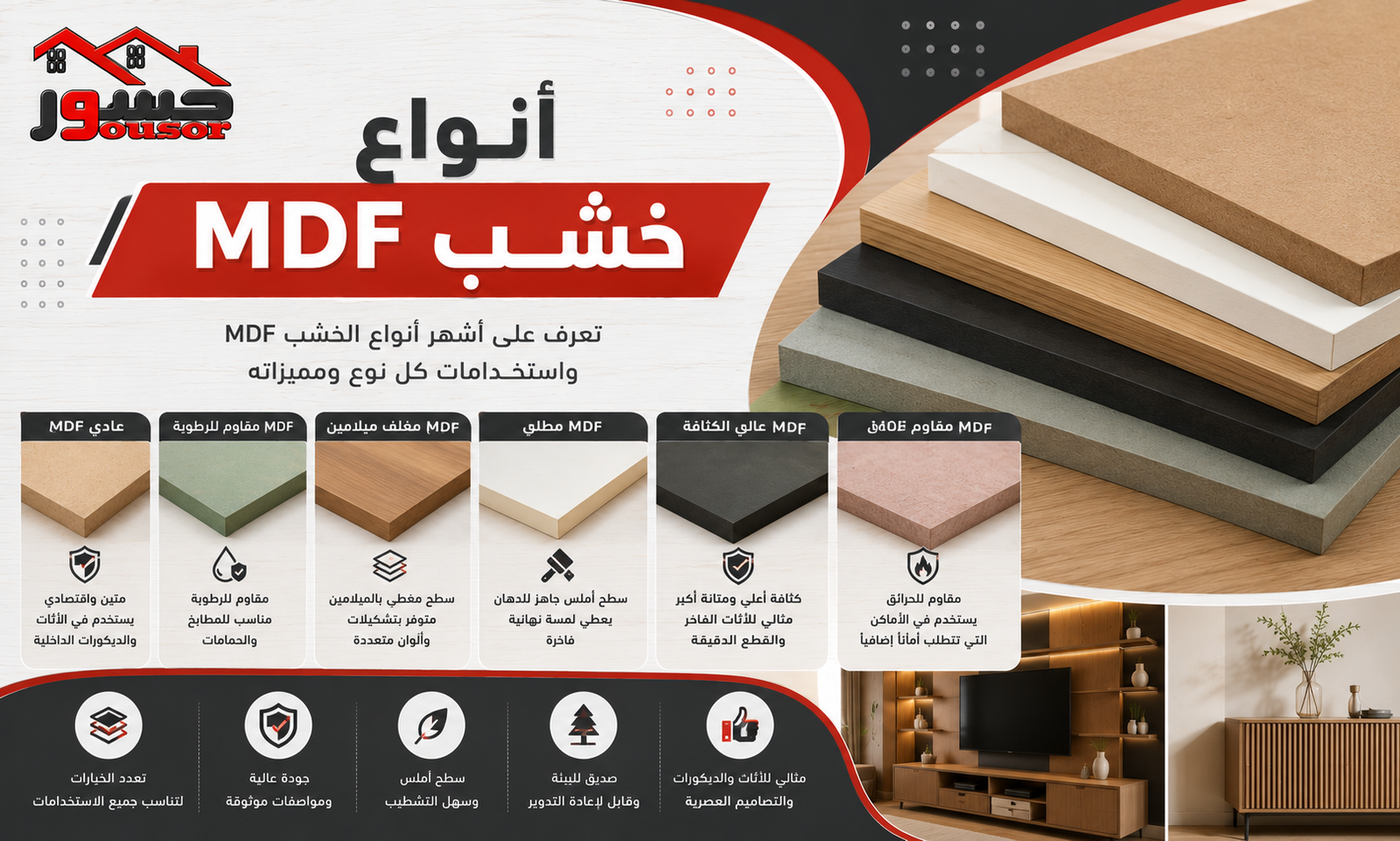
The types of MDF available on the market today are no longer limited to the familiar standard white variety; they have expanded to include specialized grades, each tailored to a specific application with specifications that differ entirely from the others.
This diversity makes distinguishing between the various types a task requiring precise technical knowledge, as using the wrong type for an unsuitable application can lead to results that do not align with project requirements.
In this article, we provide a detailed overview of the most prominent types available on the market, outlining the characteristics and optimal use cases for each, so you can confidently choose the best option for your project.
What is MDF, and why is it a top choice in modern manufacturing?
MDF is an engineered wood product made from fine wood fibers mixed with resin under high pressure and heat, resulting in a homogeneous mass free of the knots or voids characteristic of natural wood.
This perfect uniformity provides a smooth surface ideal for precision finishing—whether through painting, coating, or lamination with melamine and natural veneer.
This type of wood is a leading choice for modern manufacturing due to the ease with which it can be shaped and cut with high precision—without cracking—as well as its dimensional stability, which makes it less prone to shrinking or expanding compared to natural wood in response to changes in ambient humidity.
Main types of MDF in the market
MDF varieties available on the market are categorized according to distinct manufacturing and functional characteristics, with each type serving a precisely defined application.
Malaysian MDF and Its Manufacturing Properties
Malaysian MDF enjoys a strong market reputation due to its consistent density and uniform specifications across production batches, making it a reliable choice for furniture projects that require high machining precision.
Colored MDF boards for ready-to-use finishes
Colored MDF panels offer a practical solution for projects requiring a quick finish without the need for additional painting stages, as they come with a uniform color layer ready for immediate installation.
Moisture-resistant MDF (green) for humid environments
Moisture-resistant MDF is manufactured by adding special substances that reduce water absorption by the fibers, making it a suitable choice for kitchens, bathrooms, and high-humidity environments.
High-gloss MDF for modern designs
High-gloss MDF features a sleek, reflective surface that lends a luxurious, modern feel to spaces; it is widely used for modern kitchen cabinetry and high-end furniture pieces.
MDF with natural veneer for a luxurious wood look.
Natural wood veneer MDF combines the stability of an engineered core with the authentic look of natural wood; the MDF substrate is overlaid with a genuine wood veneer, lending the finished piece a visual warmth that is difficult to achieve with other synthetic alternatives.
Key differences between MDF types in terms of performance and usage.
MDF types differ in terms of moisture resistance, final appearance, and the nature of their suitable applications; the most notable of these differences can be summarized as follows:
- The moisture-resistant type excels in humid environments such as kitchens and bathrooms, whereas it is unnecessary for dry applications, where the less expensive standard type suffices.
- The high-gloss finish offers a luxurious, contemporary look that suits modern designs, though it does not harmonize with every style of décor.
- The natural veneer finish conveys a warm, authentic feel that complements classic or semi-luxurious décor, contrasting with the purely industrial look of other types.
- The pre-colored type offers a quick solution for applications requiring an immediate finish without additional painting stages.
For a precise distinction between these types and a comparison with another common market option, you can refer to the article on the difference between MDF and melamine, which details the practical differences between them.
MDF prices in the market
MDF prices in the market vary based on several factors, most notably the specific type required; the standard grade is the least expensive, while prices rise progressively for moisture-resistant, high-gloss, or natural veneer-faced varieties.
Panel thickness and manufacturing origin also influence the final price; panels from reliable sources with consistent specifications typically command a relatively higher price compared to budget alternatives of uncertain quality.
To obtain an accurate price quote tailored to the project’s requirements, it is advisable to clearly specify the desired type and thickness when requesting a quote from the supplier. Additionally, one should review the specific applications for different MDF grades to ensure the most suitable type is selected without incurring unnecessary costs.
Factors influencing the pricing of MDF wood
MDF prices are influenced by several key factors that determine the final cost of the board, most notably:
- The specific type of board; the standard type is the least expensive compared to specialized types.
- Moisture resistance: prices for water-resistant treated panels are higher than those for standard types.
- Gloss level and surface finish: high-gloss panels command a higher price due to the cost of additional processing.
- The type of exterior finish—whether a solid color or natural wood veneer—as natural veneer significantly increases the price.
- Panel thickness: the greater the thickness, the higher the cost, depending on the quantity of raw material used.
- Manufacturing origin: panels from reliable sources with consistent quality specifications command a relatively higher price compared to unverified, budget-friendly alternatives.
Key drawbacks of MDF wood to know before choosing
Despite the numerous advantages MDF offers in terms of uniformity and ease of processing, making the right choice requires a thorough understanding of its inherent weaknesses—shortcomings that can escalate into serious problems if the material is used in an unsuitable application.
Relatively heavy weight compared to other types of wood.
MDF is characterized by high density resulting from the tight compression of fine fibers; the very density that ensures its uniformity also makes it heavier than natural wood or even plywood of the same thickness. This factor presents additional challenges when manufacturing large furniture pieces, as hinges and supports require stronger structural reinforcement to bear the extra weight without sagging over time.
High moisture sensitivity in the untreated standard type.
With the exception of varieties specifically designed and treated for water resistance, standard MDF absorbs moisture relatively quickly when directly exposed to water or continuous steam; this causes the fibers to swell and the edges to expand—damage that is difficult to repair later. Consequently, using standard MDF in humid environments like kitchens or bathrooms—without verifying its actual resistance rating—is a common mistake that leads to the premature deterioration of the finished product.
Reduced nail and screw holding capacity upon repeated fastening.
Due to its homogeneous fibrous structure—which lacks the cohesive longitudinal fibers found in natural wood—MDF loses its screw-holding strength if the same component is repeatedly disassembled and reassembled in the same location. This drawback makes it less suitable for furniture requiring frequent assembly and disassembly, necessitating the use of specialized fastening techniques—such as threaded inserts or structural adhesives—to enhance structural integrity.
Formaldehyde emission in low-quality varieties
Some budget-friendly types of MDF rely on resins containing higher levels of formaldehyde, which can pose a health concern in poorly ventilated indoor environments—particularly in children’s rooms or small living spaces. Therefore, it is always advisable to select boards that hold recognized certifications guaranteeing that emissions remain within internationally accepted safe limits.
Difficulty of repair in the event of a fracture or localized damage.
Unlike natural wood, which can be sanded or partially restored if scratched or slightly damaged, the homogeneous composition of MDF makes spot repairs more difficult; often, the entire piece must be replaced rather than restored, particularly with varieties featuring a melamine or veneer finish.
How do you choose the right type of MDF for your project?
Selecting the appropriate type of MDF requires considering several interrelated factors to ensure the final product meets project requirements, most notably:
- First, determine the end-use environment: kitchens and bathrooms require moisture-resistant types, whereas dry rooms can use standard ones.
- Evaluate the desired final appearance by choosing a high-gloss finish for modern designs or natural wood veneer MDF for a warm, wood-like look.
- Taking into account the required speed of execution, as pre-finished colored panels offer a quick solution without the need for additional painting stages.
- Assessing the nature of the load and functional usage is essential; components subject to repeated assembly and disassembly require additional reinforcement, regardless of the type selected.
- Comparing the selected type with close alternatives—such as melamine wood specifications—to ensure the choice is truly the most suitable for the specific application.
- Reviewing the detailed applications of MDF to ensure the selected type serves the intended functional purpose.
- Verify certified quality and emission certificates before purchasing, especially for residential projects and children’s rooms.
Frequently Asked Questions About Types of MDF
What are the best types of MDF in Saudi Arabia?
Malaysian MDF is considered one of the best types available in Saudi Arabia due to its consistent specifications and uniform density; moisture-resistant varieties are preferred for kitchens and bathrooms, while natural veneer-faced types are favored for luxury furniture.
Is green MDF completely water-resistant?
No, the type known as “green MDF” is moisture-resistant rather than fully waterproof; while it reduces water absorption by the fibers during incidental exposure, it remains unsuitable for direct submersion or continuous exposure to water.
What is the average price of an MDF board?
The average price of an MDF board varies depending on type, thickness, and origin; the standard type is the least expensive, while prices increase for moisture-resistant or natural veneer-faced varieties. It is recommended to request a direct price quote from the supplier.
What are the main disadvantages of MDF?
The main drawbacks of MDF include its relatively heavy weight, poor screw-holding capacity upon repeated installation, susceptibility to moisture (in untreated varieties), and the difficulty of performing localized repairs in the event of breakage or damage.